
Practising with your nervous system and each other in complex times.
There is a lot going on in the world. Ways of being and living are no longer tenable. Life as we have known it is shifting and changing. This can create a slight agitation in our being – a subtle hum beneath the surface that influences our stress levels, our physiology, and our capacity.Often overwhelm does not arrive as a single event, but as an accumulation: an inbox that never empties, a feed full of interlinked crises, a friend who is not doing well, and a body that feels tense and may not be able to rest.When this is going on for me, I talk about it as a crunchy time.It is more than busy … more like a background pressure where my nervous system is working hard just to keep up.At these times, I notice how sharp my language can be, and how quickly I can flip from being the person I want to be. My usual curiosity, care, presence, and ability to relate smoothly can turn into withdrawal, pleasing, over‑functioning, or annoyance.Nothing much may have changed on the outside. Internally, my system has moved from connection to protection. My behaviour reflects that I do not feel safe, and my capacity to respond, rather than react, is compromised.I talk about this as response‑ability: the capacity to pause, notice what is happening, and choose how to respond.Flipping our lid
An analogy I love to use when teaching comes from Daniel Siegel (you can find his short video explanation online).- Your wrist and palm represent the brainstem and limbic system – the parts that deal with survival, emotion, and basic bodily functions.
- Your fingers curled over the top represent the neocortex – the parts that help with decisions, planning, empathy, language, perspective‑taking, and sense‑making.
- Snapping at a small request
- Saying yes while every part of you is a no
- Going blank in a conversation and not being able to find words
- Numbing out with screens or busy‑work
A simple map for crunchy moments
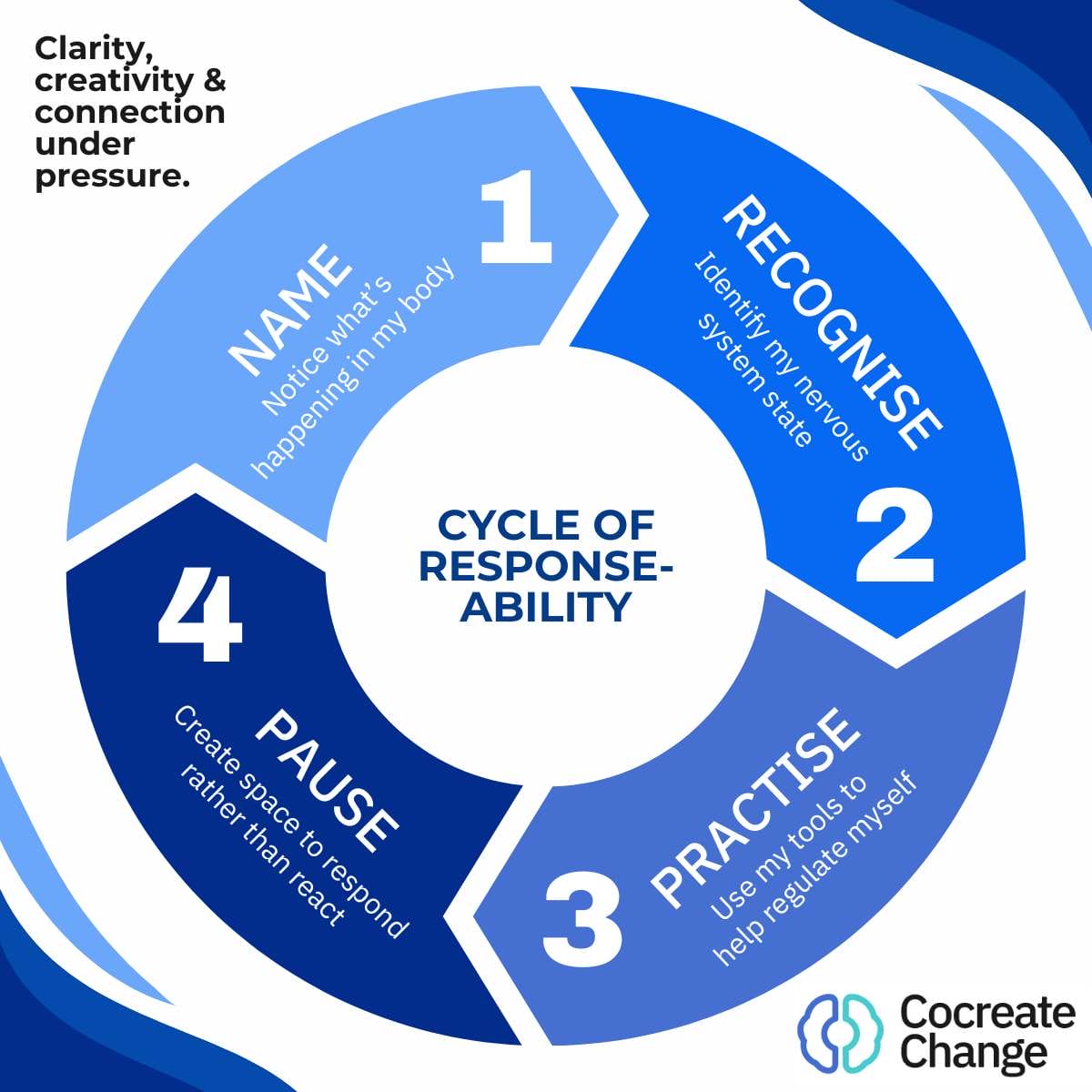
When our lids flip, we do not get to choose our first reaction. But we can grow the conditions for a different second move.One simple way I work with this is a four‑step loop: Name → Recognise → Practise → Pause.1. Name
First, we name what is happening, as concretely as we can:- “My jaw is tight and my shoulders are up by my ears.”
- “My chest feels hollow and I can’t quite feel my legs.”
- “The palms of my hands feel hot.”
- “I’ve read the same sentence three times and none of it has gone in.”
2. Recognise
Then we recognise the flavour of what is happening.That might be as simple as:- “Oh, this is that wired, edgy feeling again.”
- “This is the flattening, nothing‑seems‑worth‑it state.”
- “I feel frozen and I just can’t feel anything right now.”
- “I’ve got to get out of here.”
- “If I keep everyone happy, I’ll be OK.”
- “I can’t decide. I just don’t know what to do.”
3. Practise
Next comes practise: one small thing that nudges your system towards a little more regulation. The important thing is that the practice matches where you actually are, not where you think you “should” be.It does not have to be grand. It might be:- Three breaths where you make the exhale slightly longer than the inhale
- Feeling the contact of your feet on the floor and looking around the room, naming three things you can see
- Standing up, shaking out your hands for 20 seconds, then sitting down again
- Texting a friend who helps your system feel a tiny bit less alone
4. Pause
Finally, we pause, even momentarily, before we act.That might be:- Letting one full breath pass before you answer the question
- Saving the email to drafts and revisiting it ten minutes later
- Saying, “I need a moment; can we come back to this?”
A little experiment for your week
You do not need to turn this into a big project.For this week, you might simply try:- Once a day, when you notice a spike or a slump, move through just the first two steps: Name and Recognise.
- If there is capacity, add one tiny practice and one breath of pause.
- What was happening around you?
- What did you notice in your body?
- What did you try? Did it help, even 5%?
Practising in community
Our nervous systems are social. We steady and unsteady each other all the time, often without realising it.That is part of why I’m opening Being with your nervous system in complex times, a small, live online practice circle for people who are already holding a lot in complex work and life.Over four sessions we’ll explore how these times land in our bodies and relationships, get curious about patterns like overwhelm, shutdown and over‑functioning, and experiment with simple practices you can actually use in the middle of real projects and everyday life.We’ll move slowly through a simple map together, weaving just enough theory with grounded practices, reflection and conversation, so you can try things out in company rather than figuring it all out alone.If something in this piece resonates and you’d like a small place to learn and practise, you’re very welcome to join us.We’ll begin in July with 2 small groups of around 10 people, to suit different time zones. If you’d like to be part of this round, you can find the details and registration here.Info & registration :
Cohort 1 : Australasia and US 8:00–9:15 am AEST = 6:00 – 7:15 pm EDT = 3:00 – 4:15 pm PDTJuly 7, 21, Aug 4, 18Cohort 2 : Australia and Europe 19:00–20:15 AEST = 10:00-11:15 am GMT = 5:00 – 6:15pm Singapore)
July 8, 22, Aug 5, 19